The Odyssey (2026)
August 3rd, 2026
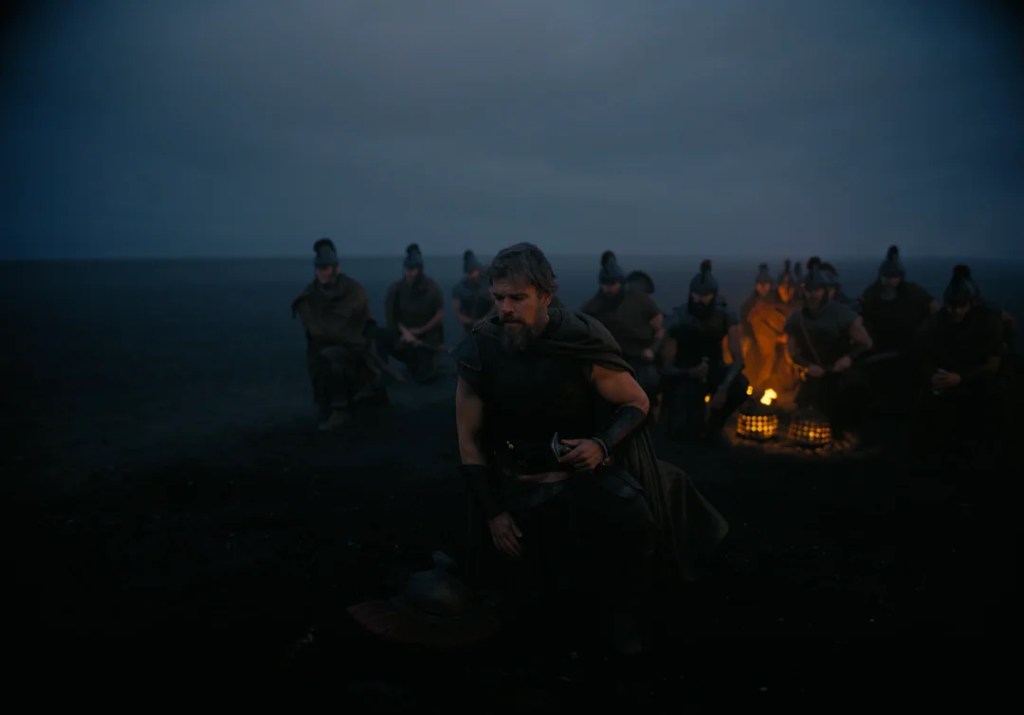
So far beyond parody.
IMAX 70mm as a shooting format for narrative films has made some sense in the past. Nolan is the originator of such practice, and while nothing in The Dark Knight is worth a second glance, his use of IMAX 70mm in short segments for large action setpieces and establishing shots proved itself as a reasonable exercise. There are quite a few reasons for this format to be used exclusively for just a few minutes at a time. The size of the frame requires the depth of field to be extremely thin barring the use of a very long lens, the camera is quite loud and makes recording live sound nearly impossible, the magazine size allows for a maximum of three minutes of recording time before a reel change, the list goes on.
It was inevitable that Nolan would eventually try to shoot a feature in the format, but it’s quite unfortunate that that feature ended up being The Odyssey. It’s almost as if Nolan was reaching for the film that would give him the most possible trouble when testing a new shooting format. The Odyssey was shot across six countries (including the Moroccan-occupied Western Sahara), on a relatively tight 91 day shoot over five months, and it shows. The film is a complete editorial nightmare from start to finish, with a staggeringly low average shot length. In one scene, a standard close-up shot cuts mid line read to the exact same framing but a different take. The first few lines of dialogue in the film, a conversation between Telemachus and Antinous, is shot in a standard shot-reverse-shot, and cuts at random. Mid-line cuts to what in any other film would be a reaction shot, in The Odyssey is Tom Holland staring blankly into space. But what he is looking at is a mirror. Nolan and Co., in addition to creating a brand new IMAX 70mm camera for the film, created a mirror system for shooting dialogue scenes, as the blimp surrounding the camera necessary for live audio to be captured is too large, and doesn’t allow the actors to be looking at one another. Don’t you think that at this point one would reevaluate what their true motivations are? What they truly want and whether their selfish fetishistic indulgences are getting in the way of their creative process? None of this is to even mention the fact that the film was proudly shot for five distinct aspect ratios. Nolan and Hoytema are really pushing the boundaries on how compromised every single image in a film can be.
With a tight schedule, not much wiggle room, and an analog workflow, Nolan was essentially flying blind through these shoot days. Once the cast and crew have already moved on to the next location, the dailies come back to show that yes, inevitably, every shot is out of focus. Whoops. Not much they can do about that! It looks like it’s August 2025 and they have already sold tickets for the opening weekend (less than a year away) of the film they are still shooting. And this edit is going to be tough! Working around the zero coverage that was shot and most takes being out of focus, there isn’t much they can do other than cobble together the best they’ve got and call it a movie.
In the third act of Christopher Nolan’s The Odyssey, Anne Hathaway performs a dramatic monologue towards (through a pathway of mirrors) Tom Holland. It is intense, and is certainly meant to be one of the more emotional scenes in the film. Hathaway is moving towards and away from the camera as she speaks, giving emphasis to her words. I’m not sure exactly what she was saying, because I was too distracted watching Keith Davis try desperately and fail horribly to pull focus and keep up with Hathaway’s unrehearsed movements. In the following scene (another intense and narratively important one), someone is speaking to Polybus, and the focus is pushed past him to an extra sitting on the bench behind him. This extra is in perfect focus, and I was just waiting for him to get up and say something. This situation is maintained through the following two cuts back to the same shot.
The water is a different color in every single shot in this movie. This is mostly due to Nolan’s boneheaded commitment to an analog process. Regardless of the fact that the film was assembled digitally and then the negative was cut using that information, regardless of the fact that modern technology was used to invent a brand new camera to make this film possible, Nolan’s fetish for the analog stops him short of color-correcting his film. This results in some insanely blown out images, some washed out images, and the aforementioned color-changing water, sometimes all in one scene. All of the other classic Nolan-isms are here as well: unintelligible action, boring center framing, and a monologue at the end of the film explaining to the audience what the film is about and how we are supposed to feel about it, just in case there was any confusion. The film is rated R, and yet like all of Nolan’s previous releases (barring maybe his first three features), the film is made for children. As an adult child himself, Nolan is quite afraid of sex, violence, and any subtextual meaning. I don’t know much about the poem the film is based on, but from what I have gathered making a film adaptation with little to no sex, nudity, or real violence is a disgrace.
And of course, the film was released to raving reviews. I don’t like to engage in this sort of commentary, but Nolan is one of the more culturally prevalent artistic voices who could release a three hour fart compilation and have it be lauded by all audiences (Swift has a very similar following). If this film was released in its exact current form by any other individual, it would be getting mixed reviews and would rightfully be called a mess. But Nolan has very carefully crafted his image as a committed formalist and celluloid enthusiast, and people today struggle very hard to differentiate a perceived “cinematic” quality from their own personal taste (see Sinners).
Benny Safdie speaking, as in Oppenheimer, is incredibly embarrassing.
What I did like was the interior of the Trojan horse and when James Blake started humming during the film. I also enjoyed Pattinson’s performance, and love that Travis Scott is here.

